A China-friendly GitHub downloader: mirror speed-test + aria2 multi-source parallel
When you build an embedded distro, downloading is often the biggest time sink: assets are scattered across GitHub, direct connections are slow/flaky, and any single proxy is up and down.
This post is about a downloader I wrote: scripts/gh-download.sh.
- Direct from this site: https://embedai.com.cn/dl/gh-download.sh
- Source repo: https://github.com/zishuowang696/gh-download
- Windows version:
gh-download.ps1(same repo; direct: https://embedai.com.cn/dl/gh-download.ps1) - Local Web UI (single file): https://embedai.com.cn/dl/gh-download-ui.ts → run
bun gh-download-ui.ts, openhttp://localhost:8787(list assets, pick, download)
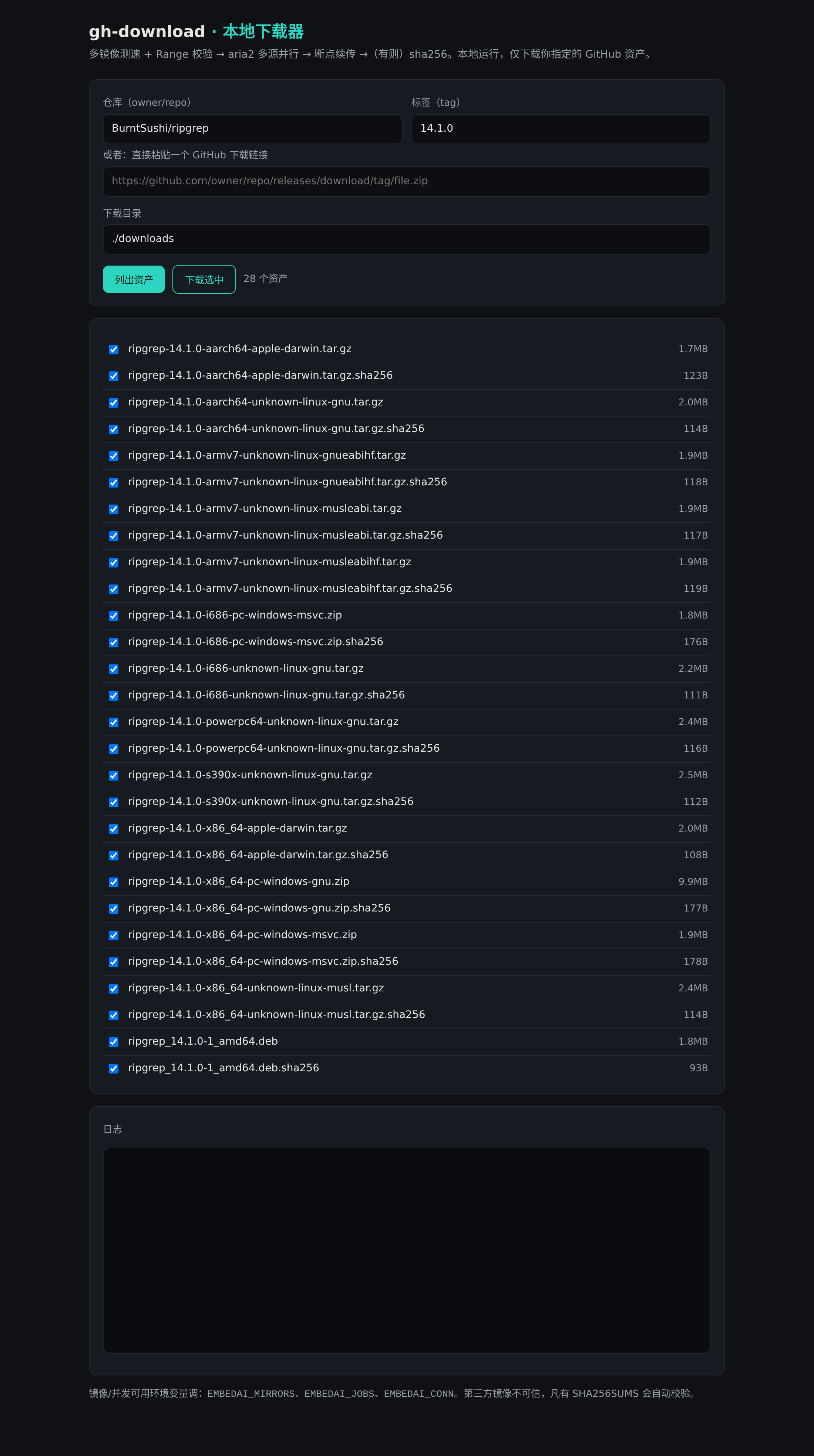
The core idea (one line)
First filter mirrors with a Range request (resumable), then let aria2 pull the same file from several mirrors in parallel.
It's not "try one mirror, fall back to the next" — it's many mirrors pulling the same file at once.
Three key details
1. Only trust mirrors that support Range (HTTP 206)
Some proxies return 200 (full body) and don't support resume — that breaks parallelism/resume. So probe first:
code=$(curl -s -o /dev/null -w '%{http_code}' -r 0-0 --max-time 20 "$url")
[ "$code" = "206" ]   # qualifies as a good mirror
**2. Put multiple mirrors for the same file on the same line (TAB-separated)**
This is the easiest trap: written as separate lines, aria2 will download the same file twice; on one line with multiple URIs, it treats them as mirror sources.
https://ghproxy.net/<url>\thttps://ghfast.top/<url>
  out=file.zip
3. Resume + verify
aria2c -c (resume); and if a SHA256SUMS is in the same batch, it runs sha256sum -c automatically — third-party proxies are not to be fully trusted.
Usage
# by owner/repo + tag (auto-lists assets, --pattern to filter)
scripts/gh-download.sh <owner/repo> <tag> [--pattern GLOB]... [-d DIR]

# or a direct GitHub download URL
scripts/gh-download.sh https://github.com/<owner>/<repo>/releases/download/<tag>/<file>

# e.g. one specific part
scripts/gh-download.sh zishuowang696/embedai sstate-jetson --pattern 'sstate-*.part-*' -d ./sst
Env vars: EMBEDAI_MIRRORS (space-separated mirrors, default ghproxy.net + ghfast.top, must support Range); EMBEDAI_JOBS (parallel files, default 4), EMBEDAI_CONN (connections per file, default 8).
Deps: curl; aria2c (recommended — falls back to curl with install hints if missing); gh needed to list assets by owner/repo (otherwise it uses the public API + jq/python3).
Real test (actual output)
Trying a normal asset (ripgrep's musl build, 2.4MB):
$ scripts/gh-download.sh BurntSushi/ripgrep 14.1.0 --pattern '*x86_64-unknown-linux-musl.tar.gz' -d /tmp/dl-test
镜像可用(Range): https://ghfast.top
开始下载 → /tmp/dl-test
[#48d111 1.6MiB/2.4MiB(66%) CN:1 DL:131KiB ETA:6s]
Download Results:
gid   |stat|avg speed  |path/URI
48d111|OK  |   191KiB/s|/tmp/dl-test/ripgrep-14.1.0-x86_64-unknown-linux-musl.tar.gz
(无 SHA256SUMS,跳过校验)
完成 → /tmp/dl-test- Here only
ghfast.toppassed the Range probe (ghproxy.netdidn't at the time) → it used just that one; - If both pass, it puts both mirrors on one line and downloads in parallel.
Large-file test: try the Ghidra 12.1.4 release (543 MB):
$ scripts/gh-download.sh NationalSecurityAgency/ghidra Ghidra_12.1.4_build --pattern '*PUBLIC*.zip' -d ./ghidra
[#4fa3b8 543MiB/543MiB(99%) CN:1 DL:76KiB ETA:3s]
Download Results:
4fa3b8|OK  |   4.7MiB/s|./ghidra/ghidra_12.1.4_PUBLIC_20260921.zip
完成 → ./ghidra- 543 MB at 4.7 MiB/s, in one go (multi-mirror parallel);
- vs. direct/single-mirror ~0.19 MiB/s → ~20× faster.
Tips / gotchas
- Mirror quality changes over time: so the script tests speed/Range first, never hard-codes one;
- Third-party mirrors aren't trustworthy: verify sha256 whenever you can;
- Don't pull sensitive content through public proxies;
- Missing aria2 = much slower (curl fallback), so
apt install aria2first.
One line
**Turn "which mirror" from a guess into a Range check, then let aria2 treat several mirrors as mirror sources — GitHub downloads on a restricted network get steady.**
(If it's tens of GB of build deps, don't proxy file-by-file — use GitHub Actions as a download proxy: see GitHub download acceleration and CI caching.)
Comments 0
No comments yet — be the first!
Log in Log in to comment